The
introduction of nanotechnology created a paradigm shift, opening myriad new
pathways for the exploration of both science and art. While modern
nanotechnology can be traced back to Physicist Richard Feynman’s 1959 talk,
“There’s Plenty of Room at the Bottom,” nanotech principles can be found both
in nature and in antiquity.
One of the
oldest examples of nanotechnology is a Roman cup from around AD400, the Lycurgus
Cup, made of dichroic glass, which has embedded colloidal gold and silver
nanoparticles that cause the glass to change color when light passes through
it. In nature,
the nanoscale patterns in a butterfly’s wing manipulate light waves, creating
the illusory perception of beautiful, vibrant colors.
A common applications of nanotechnology is in semiconductor manufacturing, allowing for today's compact computers.

Nanowire array I created via nanoimprint lithography, a common process in semiconductor manufacturing

3D image of nanowire array taken with an atomic force microscope

Analysis of nanowire array taken with an atomic force microscope
Nanotechnology
is prevalent in our everyday lives, even though we generally don't realize it. Some
modern clothing contains nanoparticles to give them stain and wrinkle
resistance, as well as antimicrobial properties. Another application of
nanoparticles is in food packaging, often to keep it from spoiling.
Unfortunately, there’s no regulation of this in the United States, leading to
toxic nanoparticles leeching into the food without the consumer’s knowledge.
Nanotechnology
is on the forefront of scientific research, leading to revolutionary products
such as lab-on-a-chip, which combine multiple laboratory functions onto a
single microchip. It has also paved the way for the possibility of
drug-delivering nanoparticles, which could increase the potency and decrease
the side effects of conventional drugs.

Technological
applications aside, nanotechnology can be used to create unbelievably small art
pieces, such as Dirty Dice.
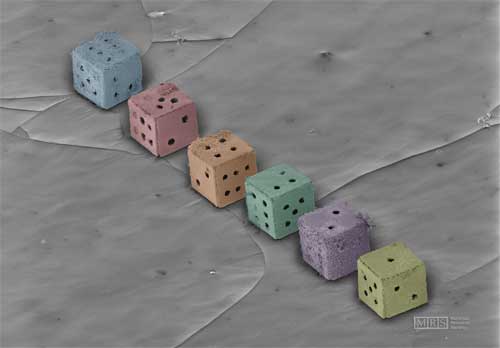
Dirty Dice: Imaged with a scanning electron microscope, each
die measures 200 microns across
Source: http://www.nanowerk.com/news/newsid=3811.php

My attempt at nanoscale art: SEM image of a happy face, create using electron beam lithography
Now that we have the ability to manipulate individual atoms, there are very few limits to what we can create, given an infinite amount of time. As research in the field of nanotechnology continues, there's no telling what amazing technologies will result.
Works Cited
Daw,
Rosamund. "Nanotechnology Is Ancient History." Theguardian.com.
Guardian News and Media, 24 Apr. 2012. Web. 26 July 2014.
<http://www.theguardian.com/nanotechnology-world/nanotechnology-is-ancient-history>.
Duncan,
Timothy V. "Applications of nanotechnology in food packaging and food
safety: barrier materials, antimicrobials and sensors." Journal of
colloid and interface science 363.1 (2011): 1-24.
Fair,
Richard B. "Digital microfluidics: is a true lab-on-a-chip
possible?."Microfluidics and Nanofluidics 3.3 (2007): 245-281.
Gimzewski,
Jim, and Victoria Vesna. "The nanoneme syndrome: Blurring of fact and
fiction in the construction of a new science." Technoetic arts 1.1
(2003): 7-24.
Kaounides,
L., Hailing Yu, and T. Harper. "Nanotechnology innovation and applications
in textiles industry: current markets and future growth trends."Materials
Science and Technology 22.4 (2007): 209-237.
De
Jong, Wim H., and Paul JA Borm. "Drug delivery and nanoparticles:
applications and hazards." International journal of nanomedicine 3.2
(2008): 133.

I really like how you experimented with Nano Art and that you included it in your blog post. I also liked that you used images from outside of lecture.
ReplyDeleteI love that you have explored the Nano Art (SEM). I did not even know you could make a structure such as the dirty dice. I do hope in the future that we can use nanotechnology to regenerate new limbs by using nano mimicry. Do you think using nanotechnology for food packing is appropriate?
ReplyDelete