Throughout
this course, we’ve seen art and technology evolve hand in hand, and space
exploration presents no exception. Across history, people have looked to the
space with great fascination. Our ancient ancestors found and named patterns in
the stars, giving birth to constellations.
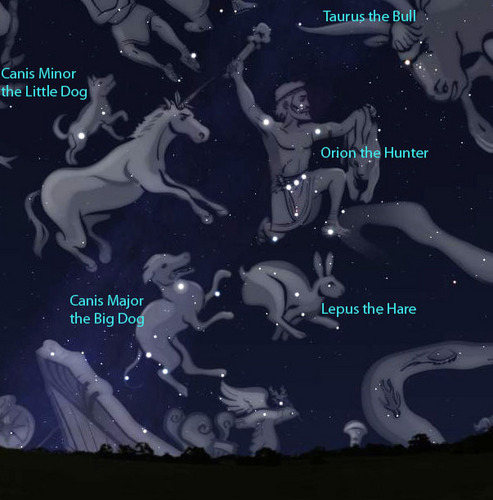
Constellations: artistic interpretation of the heavens
Source: <http://www.universetoday.com/19516/constellations/>
As
technology enabled us to learn more about space, artists took that information
and extrapolated on it, playing on the public interest of the unknown. Ray
Bradbury’s short stories from the 1940’s and 50’s, later compiled into “The
Martian Chronicles,” imagines the colonization of Mars and the conflicts that
could arise between the colonists and native Martians.

Cover art for "The Martian Chronicles,"envisioning aboriginal Martians and their planet
Source: <http://dear-american.com/2013/01/23/rereading-the-martian-chronicles/>
After the
launch of the Sputnik satellite propelled us into the Space Age, kicking off
the space race and putting space exploration at the forefront of public
consciousness, the prevalence of space travel in popular culture exploded. The
advert for the TV series “Lost In Space” commented that the show’s characters
are “taking off for the stars, a journey that no longer seems as far out and
fantastic as it would have only a few years ago, for now we live in the space
age” (Vesna, 2012).
The concept
of space exploration in popular culture isn’t limited to film and television
series such as The Jetsons and Star Trek. The infamous Sports Illustrated
Swimsuit Edition 2014 issue features model Kate Upton floating in zero gravity.

Swimsuit model Kate Upton in zero gravity
Source: <http://swimsuit.si.com/swimsuit/models/kate-upton/zero-g-photos>
Additionally, artists have the ability to use space as a
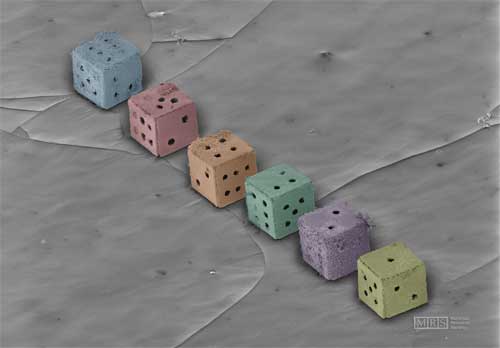
medium, such as in Joe Davis’ Microvenus that was discussed in BioTech+Art.
Space exploration
development in the United States has begun to transfer from
governmental organizations such as NASA to private companies such as SpaceX,
potentially starting a new age in consumer-driven space travel. This era could present a host of complex issues, such as who has territorial or mining rights on extraterrestrial bodies.
Works Cited
Bachman, Justin. "Elon Musk
Wants SpaceX to Replace Russia as NASA's Space Station Transport." Bloomberg Business Week. Bloomberg, 30
Apr. 2014. Web. 27 July 2014. <http://www.businessweek.com/articles/2014-04-30/elon-musk-wants-spacex-to-replace-russia-as-nasas-space-station-transport>.
Bradbury, Ray. The
Martian Chronicles. Garden City, NY: Doubleday, 1958. Print.
Dickson, Paul. "Sputnik's
Impact on America." PBS, 06 Nov. 2007. Web. 26 July 2014.
<http://www.pbs.org/wgbh/nova/space/sputnik-impact-on-america.html>.
Hussain, Zareena. "Science
as Art Unites Disciplines." The Tech.
Massachusetts Institute of Technology, 9 May 2000. Web. 28 July 2014.
<http://tech.mit.edu/V120/N26/bioartists.26f.html>.
Kramer, Miriam. "Kate Upton
Goes Zero-G for Sports Illustrated's 2014 Swimsuit Issue." Space. 18 Feb. 2014. Web. 28 July 2014.
<http://www.space.com/24726-kate-upton-zero-g-sports-illustrated.html>.
Miller, Todd. "Space
Exploration and the Culture of Innovation." SF Gate, 28 Mar. 2014. Web. 27
July 2014.
<http://blog.sfgate.com/tmiller/2012/03/28/space-exploration-and-the-culture-of-innovation-an-interview-with-neil-degrasse-tyson/>.
Vesna, Victoria. "Space
Pt5." YouTube. University of
California Online Program, 30 May 2012. Web. 25 July 2014. <https://www.youtube.com/watch?v=WnSUHMXBmdg>.