Thursday, August 7, 2014

Friday, August 1, 2014
Event 3: Senses + Perception
On July 28th I attended
“Senses + Perception” at the UCLA California NanoSystems Institute. The
presentation discussed how the information we take in through our five senses
shape our perception of our environment and how we can, in turn, use what we
know about perception to trick our senses. Our five senses give us all of the
information we take in from the world around us and allow us to interact with it.
All artists utilize the science of perception, presenting the viewer with an
experience that invokes thought or emotion.

Young Lady or Old Woman?
Playing on your perception of the image, you can see one or the other, but not both simultaneously
Source: <http://www.grand-illusions.com/opticalillusions/woman/>
Both evolution and society have a
part to play in how our senses create perception. For example, the human tongue
distinguishes which foods could be poisonous by activating the bitter taste
receptors and creating the perception of bad taste. The sense of smell plays a
huge role how we perceive attractiveness. Pheromones, which people secrete
though several areas of their body, trigger a subconscious sexual attraction.
MTV played on this idea with their 2009 dating game show “Senseless” where
contestants were deprived of sight and hearing and had to choose their blind
date via touch, smell and taste.
While
we tend to view senses as independent, the can be combined to create entirely
different experiences. In movies, cognitive association is often put to use,
invoking a particular feeling about characters or actions. In the 2011 film
Drive, the music and lighting tells as much of a story as the pictures on the
screen, cluing the viewer in on the main character’s thoughts and feelings, as
well as how they should feel about it.
Lighting and
soundtrack tell the story of who’s good, who’s bad and whether the main
character is acting morally in a given scene
The Art of Trance: Swarm
The animals in
their natural environment almost seem to dance to the music. Watching the video
with and without sound creates vastly different experiences
It’s also possible to use one sense to
stimulate another. In Tlon, three conductors use their arms as if they were
conducting an orchestra. Despite no sound being produced, the perception of
sound is created in the viewer’s mind.
Tlon
Source: <https://www.youtube.com/watch?v=F4KFDuilStc>
Those born without a certain sense
can make up for it by using their other senses to supplement their perception.
People who are deaf or mute can use sign language to communicate by sight. One
blind man uses the science of echolocation to “see” his environment my clicking
his tongue and listening to how it bounces off objects.
I
would definitely recommend this lecture. It helped me understand how not only
can science and art intermingle, but also how the science of perception changes
how we view and feel about both art and our environment.

Another Professor Vesna spotting (see left)
Works Cited
Finkel, Michael. "The Blind Man
Who Taught Himself to See." Men's Journal, Mar. 2011. Web. 01 Aug. 2014.
Ganz, Jacob. "'Drive' Lets The
Songs Do The Feeling." National Public Radio, 16 Sept. 2011. Web. 01 Aug.
2014.
Solomon, Benjamin. "A Complete
History of MTV’s Dating Game Shows." The Date Report, 12 Nov. 2013. Web.
01 Aug. 2014.
Staff, NPR. "Blindness No
Obstacle To Those With Sharp Ears." National Public Radio, 13 Mar. 2011.
Web. 27 July 2014.
Grammer, Karl,
Bernhard Fink, and Nick Neave. "Human pheromones and sexual
attraction." European Journal of Obstetrics & Gynecology and
Reproductive Biology 118.2 (2005): 135-142.
Fischer, Anne, et
al. "Evolution of bitter taste receptors in humans and apes."Molecular
biology and evolution 22.3 (2005): 432-436.
Cohen, Annabel J.
"Associationism and musical soundtrack phenomena."Contemporary
music review 9.1-2 (1993): 163-178.
Sunday, July 27, 2014
Week 5: Space + Art
Throughout
this course, we’ve seen art and technology evolve hand in hand, and space
exploration presents no exception. Across history, people have looked to the
space with great fascination. Our ancient ancestors found and named patterns in
the stars, giving birth to constellations.
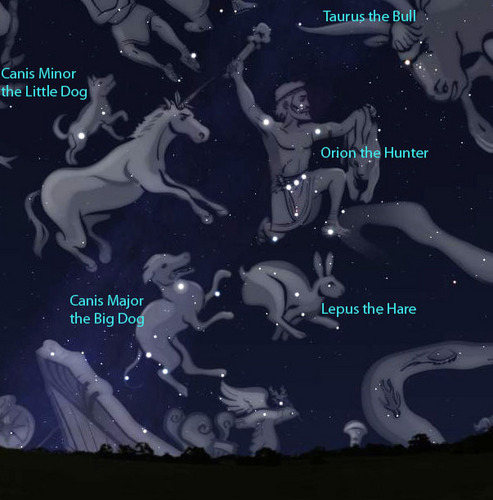
Constellations: artistic interpretation of the heavens
Source: <http://www.universetoday.com/19516/constellations/>
As
technology enabled us to learn more about space, artists took that information
and extrapolated on it, playing on the public interest of the unknown. Ray
Bradbury’s short stories from the 1940’s and 50’s, later compiled into “The
Martian Chronicles,” imagines the colonization of Mars and the conflicts that
could arise between the colonists and native Martians.

Cover art for "The Martian Chronicles,"envisioning aboriginal Martians and their planet
Source: <http://dear-american.com/2013/01/23/rereading-the-martian-chronicles/>
After the
launch of the Sputnik satellite propelled us into the Space Age, kicking off
the space race and putting space exploration at the forefront of public
consciousness, the prevalence of space travel in popular culture exploded. The
advert for the TV series “Lost In Space” commented that the show’s characters
are “taking off for the stars, a journey that no longer seems as far out and
fantastic as it would have only a few years ago, for now we live in the space
age” (Vesna, 2012).
The concept
of space exploration in popular culture isn’t limited to film and television
series such as The Jetsons and Star Trek. The infamous Sports Illustrated
Swimsuit Edition 2014 issue features model Kate Upton floating in zero gravity.

Swimsuit model Kate Upton in zero gravity
Source: <http://swimsuit.si.com/swimsuit/models/kate-upton/zero-g-photos>
Additionally, artists have the ability to use space as a
medium, such as in Joe Davis’ Microvenus that was discussed in BioTech+Art.
Space exploration
development in the United States has begun to transfer from
governmental organizations such as NASA to private companies such as SpaceX,
potentially starting a new age in consumer-driven space travel. This era could present a host of complex issues, such as who has territorial or mining rights on extraterrestrial bodies.
Works Cited
Bachman, Justin. "Elon Musk
Wants SpaceX to Replace Russia as NASA's Space Station Transport." Bloomberg Business Week. Bloomberg, 30
Apr. 2014. Web. 27 July 2014. <http://www.businessweek.com/articles/2014-04-30/elon-musk-wants-spacex-to-replace-russia-as-nasas-space-station-transport>.
Bradbury, Ray. The
Martian Chronicles. Garden City, NY: Doubleday, 1958. Print.
Dickson, Paul. "Sputnik's
Impact on America." PBS, 06 Nov. 2007. Web. 26 July 2014.
<http://www.pbs.org/wgbh/nova/space/sputnik-impact-on-america.html>.
Hussain, Zareena. "Science
as Art Unites Disciplines." The Tech.
Massachusetts Institute of Technology, 9 May 2000. Web. 28 July 2014.
<http://tech.mit.edu/V120/N26/bioartists.26f.html>.
Kramer, Miriam. "Kate Upton
Goes Zero-G for Sports Illustrated's 2014 Swimsuit Issue." Space. 18 Feb. 2014. Web. 28 July 2014.
<http://www.space.com/24726-kate-upton-zero-g-sports-illustrated.html>.
Miller, Todd. "Space
Exploration and the Culture of Innovation." SF Gate, 28 Mar. 2014. Web. 27
July 2014.
<http://blog.sfgate.com/tmiller/2012/03/28/space-exploration-and-the-culture-of-innovation-an-interview-with-neil-degrasse-tyson/>.
Vesna, Victoria. "Space
Pt5." YouTube. University of
California Online Program, 30 May 2012. Web. 25 July 2014. <https://www.youtube.com/watch?v=WnSUHMXBmdg>.
Saturday, July 26, 2014
Event 2: Nano and Bio: Why Do We Care?
On July 24th,
2014, I attended Sijie Lin’s presentation “Crossroads of Nano and Bio: Why Do
We Care.” Dr. Lin, a postdoctoral researcher at the UCLA California NanoSystems
Institute, spoke on his research regarding the effect of nanoparticles on
zebrafish embryos and why we should care.
As the
prevalence of nanotechnology increases, so does the amount of nanoparticles a
person will come into contact with on a daily basis. Some of these nanoparticle
end up being ingested by humans and many leech into the environment. In the
United States, there’s no regulation on nanoparticle use and little research
has been done on their effects on people and the environment.
Dr. Lin
researches the effect of various nanoparticles on zebrafish. These fish provide
a good model for studying both human disease and environmental toxicity because
their DNA is 90-95% similar to humans, they have a short gestation period and their
embryos are translucent, making defects easy to pinpoint and track.
Different nanoparticles
and nanomaterials are introduced to zebrafish embryos during development and
compared to a control group to see their effects. As shown below, some nanoparticles have devastating effects on the fish.

Zebrafish embryos exposed to different nanoparticles (concentration 15 μg/mL) for 72 hours following fertilization (George, Saji, et al., 2011)
Additionally,
Dr. Lin discussed how his lab embraces the integration of different fields of
research by using robotics to aid in sample preparation. In working with
zebrafish, the transfer of their embryos to individual containers for
experimentation would be the limiting factor for the number of tests that could
be run. A small robot that identifies each embryo and pipettes them into their
respective containers decreases sample preparation time from as much as one
hour down to five minutes.
Technology + Art: A robot similar to the one shown is used to visually locate individual embryos and transfer them to individual wells in the sample plates
Source: https://www.youtube.com/watch?v=3ouPBX65kXU
While
nanotechnology isn’t all bad, this research implies that many of the
nanoparticles in use, including the silver nanoparticles that we learned are prevalent
in our clothing, cosmetics and food packaging, can have adverse environmental and human side
effects. One of the larger points I've taken away from this class is that major technical innovations such as the ones that lead to the field of nanotechnology create paradigm shifts that can lead to their use outpacing the spread of information on their potential harm. Artists of many types take it upon themselves to spread this information and stimulate discussion of these topics. In the case of nanotechnology use, It’s extremely important to spread awareness and begin
regulating the use of certain nanoparticles and nanomaterials. Overall, I would strongly
recommend this event to my classmates because more people need to be aware of this alarming issue.

Sijie Lin and myself
Works Cited
Deneen, Sally. "Toxic Nanoparticles Are
Entering the Food Supply." MSN News, 29 Aug. 2013. Web. 25 July 2014.
<http://news.msn.com/rumors/rumor-toxic-nanoparticles-are-entering-the-food-supply>.
Duncan, Timothy V. "Applications of
nanotechnology in food packaging and food safety: barrier materials,
antimicrobials and sensors." Journal
of colloid and interface science 363.1 (2011): 1
George, Saji, et al. "Use of a
high-throughput screening approach coupled with in vivo zebrafish embryo
screening to develop hazard ranking for engineered nanomaterials." Acs
Nano 5.3 (2011): 1805-1817.
Kimmel, Charles B., et al. "Stages of
embryonic development of the zebrafish."Developmental dynamics 203.3
(1995): 253-310.
Spitsbergen, Jan M., and Michael L. Kent.
"The state of the art of the zebrafish model for toxicology and
toxicologic pathology research—advantages and current limitations." Toxicologic
pathology 31.1 suppl (2003): 62-87.
Xia, Tian, et al. "Decreased dissolution
of ZnO by iron doping yields nanoparticles with reduced toxicity in the rodent
lung and zebrafish embryos."Acs Nano 5.2 (2011): 1223-1235.
Subscribe to:
Posts (Atom)