While we
generally think of the brain’s sole function as controlling our body and
maintaining our consciousness, it can also be manipulated to create art through
imaging the brain, tricking the brain with illusions, and manipulating the
chemicals inside the brain. In addition to the use of Brainbow to randomly
distinguish and map individual neurons, Carbocyanine dye labeling can be used to label axon tracts in
the brain, creating beautiful, scientifically useful images.
.jpg)
Brainbow (B) and Carbocyanine dye labeling (D,E) of a mouse brain
Source: Wiring
the Brain: The Biology of Neuronal Guidance.
Some
artists exploit their knowledge of neuroscience to create optical illusions
such as Suzanne Anker’s fMRI Butterfly, which trick the brain into perceiving
images differently than they actually are. One interesting application of these
illusions is in the diagnosis of Schizophrenia. Schizophrenics, as well as some
brain injury sufferers, have facial recognition defects that prevent them from
falling for the Hollow Face optical illusion. A healthy brain sees the concave
inside of a face mask, but interprets it to be convex because the brain’s idea
of what it expects overpowers the actual visual information.
Al Seckel, a cognitive neuroscientist, explores the perceptual illusions that fool our brains
Source: <https://www.youtube.com/watch?v=GzOQLDwUAC8>
A
significantly more controversial method of creating art is through altering the
brain with hallucinogenic substances such as LSD and psilocybin. The compounds
act on the brain’s neurotransmitters, creating art in the subject’s mind when
they close their eyes, as well as influencing artistic expression. The use of
drugs to create an altered mental state has famously lead to many notable
contributions including Freud’s invention of psychoanalysis and Crick’s
discovery of the double helix structure of DNA.
Other artists famously influenced by
the effects of LSD include Aldous Huxley, Jim Morrison and Steve Jobs. Some scholars
even believe that these hallucinations were the basis for certain events in
religious scripture.
A portrait artist takes LSD and draws a man's portrait multiple times throughout his "trip"
Source: <https://www.youtube.com/watch?v=n4Sb8jCJUTw>
One
piece I really enjoyed was Bryan Lewis Saunders’ series of self-portraits, each
while on different drug. It was interesting to see how different mental states
would produce completely different images.
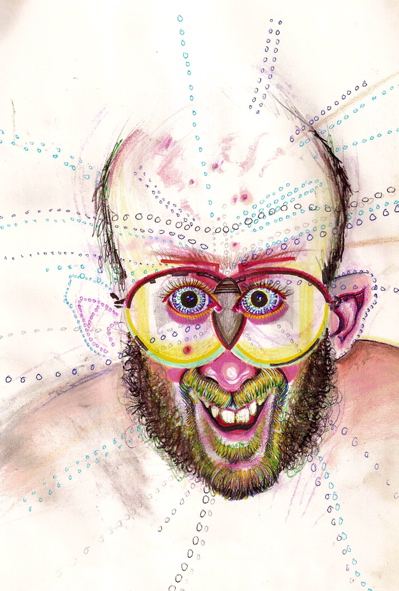
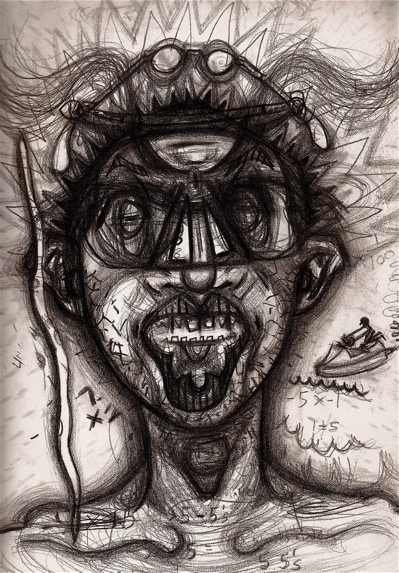
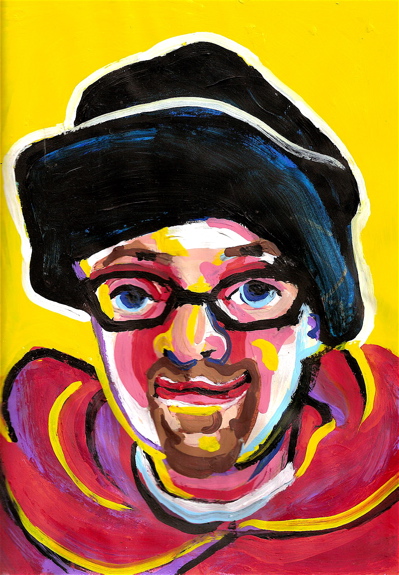
Bryan Lewis Saunders' Self Portraits on psilocybin, cocaine and salvia. (Left to right)
Source: <http://bryanlewissaunders.org/drugs/>
While
much controversy surrounds the use of life as an expressive medium, I believe
that no harm comes to society as long as artists are aware of the consequences
these procedures have on their own bodies, perform them safely and don't harm other organisms unnecessarily. Regarding the use of controlled substances, a significantly more complex issue is presented. Those under the influence may have lapses in judgment (driving while intoxicated) that put others in danger or experience brain damage as a result of improper use, creating a burden on the health care system. Consequentially, a pragmatic ethical approach must be applied to such situations.
Works Cited
Chedotal, A., and L. J.
Richards. "Wiring the Brain: The Biology of Neuronal Guidance." Cold Spring Harbor Perspectives in Biology
2.6 (2010): A001917. Web.
Dima, D., Jp Roiser, De
Dietrich, C. Bonnemann, H. Lanfermann, Hm Emrich, and W. Dillo.
"Understanding Why Patients with Schizophrenia Do Not Perceive the Hollow
Mask Illusion Using Dynamic Causal Modelling." NeuroImage 47 (2009): S135. Web.
"DRUGS." Bryan Lewis Saunders. 2008. Web. 19 July
2014. <http://bryanlewissaunders.org/drugs/>.
Frazzetto, Giovanni, and Suzanne
Anker. "Neuroculture." Nature
Reviews Neuroscience 10.11 (2009): 815-21. Web.
Ilani, Ofri. "Hebrew
University Researcher: Moses Was Tripping at Mount Sinai." Israel News. Haaretz, 4 Mar. 2008. Web.
19 July 2014.
<http://www.haaretz.com/news/hebrew-university-researcher-moses-was-tripping-at-mount-sinai-1.240589>.
Vesna, Victoria.
"Neuroscience Pt3." YouTube.
UC Online Program, 16 May 2012. Web. 17 July 2014.
<https://www.youtube.com/watch?v=E5EX75xoBJ0>.
Yglesias, Matthew. "Steve
Jobs on LSD: "A Positive Life-changing Experience for Me.""
Slate Magazine, 11 June 2012. Web. 19 July 2014.
<http://www.slate.com/blogs/moneybox/2012/06/11/steve_jobs_on_lsd_a_positive_life_changing_experience_for_me_.html>.

No comments:
Post a Comment