While the
human form has always been a prominent subject in art, advancements in medical
technology increasingly give artists new ways to use the human body as a canvas
for artistic expression. Orlan’s transformative work with plastic surgery raised
many interesting questions about society’s view of women and female beauty. I
think her decision to take physical features from famous works not for their
physical beauty, but for what they represent, brings up an interesting point
about the origin of our definition of beauty and peoples’ motives for getting
plastic surgery. There’s so much pressure for women to be pretty that it’s
caused some women to take plastic surgery way too far.
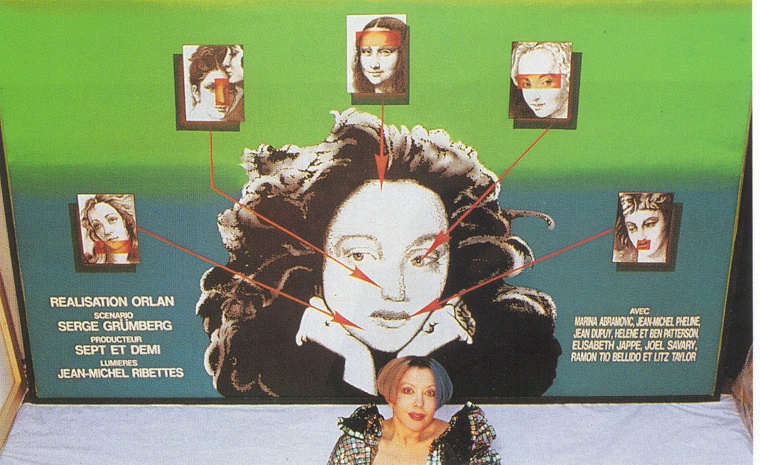
A map of Orlan's Carnal Art project, drawing features from famous works
Source: http://oldsite.english.ucsb.edu/faculty/ecook/courses/eng114em/carnal.htm

Source: http://www.gq.com/women/photos/201404/valeria-lukyanova-human-barbie-doll
I believe Professor Warwick was
spot on when he suggested that electronic medicine, as opposed to chemical
medicine, may one day become the norm. Aside from the virtual reality and
biofeedback techniques discussed by Diane Gromala, there are a number of
currently employed electronic procedures that have been proven clinically
effective. One such technique is Transcutaneous Electrical Nerve Stimulation,
which reduces pain by using electronic impulses to disrupt messages from pain
receptors and prevent them from reaching the brain.
Professor Warwick’s Project Cyborg
paved the way for the use of near field communications devices to track our
movements and increase everyday conveniences. In 2004, the FDA approved
implantable RFID chips that contain patients’ medical records, making it
possible to easily access a person’s information in case of emergency. While
implanting chips isn’t common quite yet, our cell phones, which many people
treat as an extension of their own body, can be used to track us and
automatically perform tasks such as turning up our home thermostat when we
leave work or turning off the lights when we leave a room.
While I had
always been interested in the human-machine interface, this week’s material
allowed me to view it not just as an engineering problem, but also as a form of
art. My favorite example of this is the modified Google Glass with MindRDR,
which is a wearable computer with heads-up display that can be controlled via
brain waves.

Google Glass with MindRDR: This woman augments her environment with Google Glass, controlled by her brain waves
Source: http://www.geek.com/mobile/developer-uses-brainwaves-to-control-google-glass-1598889/
Works Cited
Cook, Elizabeth H. "Orlan
and the Postmodern Female Pen." Women
Writers, 1650-1760. UCSB, 2003. Web. 12 July 2014.
<http://oldsite.english.ucsb.edu/faculty/ecook/courses/eng114em/OrlanTOC.htm>.
Gromala, Diane. "Curative
Powers of Wet, Raw Beauty." YouTube.
TEDxAmericanRiviera, 7 Dec. 2011. Web. 12 July 2014.
<https://www.youtube.com/watch?v=cRdarMz--Pw>.
Idov, Michael. "Valeria
Lukyanova, the Human Barbie Doll." GQ, Apr. 2014. Web. 14 July 2014.
<http://www.gq.com/women/photos/201404/valeria-lukyanova-human-barbie-doll>.
Jones, I., and M. I. Johnson.
"Transcutaneous Electrical Nerve Stimulation." Continuing Education in Anaesthesia, Critical Care & Pain 9.4
(2009): 130-35. Web.
"Recipes." Put the Internet to Work for You. IFTTT.
Web. 13 July 2014. <https://ifttt.com/recipes>.
Rose, Barbara. "Orlan: Is It Art? Orlan
and the Transgressive Act." Art in America 81.2 (1993):
83-125.
Vesna, Victoria. "Medicine
Pt3." YouTube. UCLA, 22 Apr.
2012. Web. 10 July 2014. <https://www.youtube.com/watch?v=FIX-9mXd3Y4>.
Warwick, Kevin. "What
Happens When a Man Is Merged with a Computer?" The University of Reading.
Web. 9 July 2014. <www.kevinwarwick.org%2FCyborg1.htm>.

Hi Alexander,
ReplyDeleteI was really shocked when you mentioned the FDA approval of implantable RFID chips. I thought in the past, people were able to implant chips into themselves because there weren't laws against it. So I assumed that this doesn't happen today because there are laws preventing it. I was really surprised that the FDA approved it. I guess it is a good idea in that doctors can easily access a patients' medical records. However, I think this also raises the issue of confidentiality. Others can create devices that can steal this information and you wouldn't know. I don't think this will be common in the future unless scientists are able to solve this confidentiality problem.
Hey Alex! I think you brought up a very interesting and controversial point about the origins of beauty and should definitely discuss more about it. The human barbie doll, its absurd how closely she resembled a barbie doll. I can't wait for the google glass to become accessible to the general public, but it may end up being another piece of technology which we rely on too much.
ReplyDeleteHey there Alex! I actually remember hearing about the RFID chips on 60 Minutes so many years back. Hard to believe it's been so long since the tech was introduced. The only issue I have with it is when these chips are able to connect to the web. At that point, I feel like the whole "big brother" thing becomes way too real, and that we'd actually have to restrain ourselves from abusing the technology to invade people's privacy. What I'd love is for medical technology to develop for the sole purpose of making the ailed live better lives, but my pessimism tells me that the technology may be used for more greed-fueled purposes.
ReplyDelete