Saturday, July 26, 2014

Week 5: NanoTech + Art

            The introduction of nanotechnology created a paradigm shift, opening myriad new pathways for the exploration of both science and art. While modern nanotechnology can be traced back to Physicist Richard Feynman’s 1959 talk, “There’s Plenty of Room at the Bottom,” nanotech principles can be found both in nature and in antiquity.

            One of the oldest examples of nanotechnology is a Roman cup from around AD400, the Lycurgus Cup, made of dichroic glass, which has embedded colloidal gold and silver nanoparticles that cause the glass to change color when light passes through it. In nature, the nanoscale patterns in a butterfly’s wing manipulate light waves, creating the illusory perception of beautiful, vibrant colors.

            A common applications of nanotechnology is in semiconductor manufacturing, allowing for today's compact computers.

Nanowire array I created via nanoimprint lithography, a common process in semiconductor manufacturing

3D image of nanowire array taken with an atomic force microscope

Analysis of nanowire array taken with an atomic force microscope

            Nanotechnology is prevalent in our everyday lives, even though we generally don't realize it. Some modern clothing contains nanoparticles to give them stain and wrinkle resistance, as well as antimicrobial properties. Another application of nanoparticles is in food packaging, often to keep it from spoiling. Unfortunately, there’s no regulation of this in the United States, leading to toxic nanoparticles leeching into the food without the consumer’s knowledge.

            Nanotechnology is on the forefront of scientific research, leading to revolutionary products such as lab-on-a-chip, which combine multiple laboratory functions onto a single microchip. It has also paved the way for the possibility of drug-delivering nanoparticles, which could increase the potency and decrease the side effects of conventional drugs. 

Cancer cells displaying phosphorescence as a result of GFP that I delivered to incubated cells via polyethylenimine nanoparticles


            Technological applications aside, nanotechnology can be used to create unbelievably small art pieces, such as Dirty Dice.
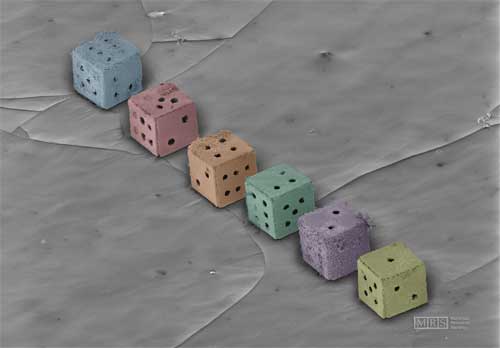
Dirty Dice: Imaged with a scanning electron microscope, each die measures 200 microns across
Source: http://www.nanowerk.com/news/newsid=3811.php

My attempt at nanoscale art: SEM image of a happy face, create using electron beam lithography

            Now that we have the ability to manipulate individual atoms, there are very few limits to what we can create, given an infinite amount of time. As research in the field of nanotechnology continues, there's no telling what amazing technologies will result.


Works Cited

Daw, Rosamund. "Nanotechnology Is Ancient History." Theguardian.com. Guardian News and Media, 24 Apr. 2012. Web. 26 July 2014. <http://www.theguardian.com/nanotechnology-world/nanotechnology-is-ancient-history>.
Duncan, Timothy V. "Applications of nanotechnology in food packaging and food safety: barrier materials, antimicrobials and sensors." Journal of colloid and interface science 363.1 (2011): 1-24.
Fair, Richard B. "Digital microfluidics: is a true lab-on-a-chip possible?."Microfluidics and Nanofluidics 3.3 (2007): 245-281.
Gimzewski, Jim, and Victoria Vesna. "The nanoneme syndrome: Blurring of fact and fiction in the construction of a new science." Technoetic arts 1.1 (2003): 7-24.
Kaounides, L., Hailing Yu, and T. Harper. "Nanotechnology innovation and applications in textiles industry: current markets and future growth trends."Materials Science and Technology 22.4 (2007): 209-237.
De Jong, Wim H., and Paul JA Borm. "Drug delivery and nanoparticles: applications and hazards." International journal of nanomedicine 3.2 (2008): 133.

Friday, July 25, 2014

Event 1: Food and Technology

           On July 25, 2014 I attended Professor Vesna’s lecture on food and technology. The lecture focused on raising awareness of what’s in the food we eat, how advances in technology have played out in the food industry, and how to use this information to be smart consumers and protect our health.

            Since the dawn of the agricultural revolution, the way we produce food has constantly been evolving. Crop rotation, the process of rotating which crops are grown in a specific area to prevent mineral depletion in the soil, as well as irrigation techniques and land availability shape the layout of the land, creating interesting patterns and shapes.


Aerial view of farmland in various parts of the world
Source: http://asterweb.jpl.nasa.gov/gallery-detail.asp?name=agmontage

            A current hot button issue centers around genetically modified (GM) food, which can be genetically engineered to express certain traits such as resistances to pests, herbicide, disease, cold, and drought. The Golden Rice project saw the development of GM rice containing vitamin A, the deficiency of which is especially prevalent in regions where rice is staple crop. If Golden Rice were to replace non-GM rice in those regions, it could help save the lives of the over half a million children under the age of 5 who succumb to vitamin A deficiency annually.

            Not everything about GM foods is great. These foods can have a negative impact on the environment, such as cross breeding to produce pesticide-resistant weeds. Additionally, the consumption of GM foods increases the risk of food-based allergies. The long-term health effects of GM foods haven’t been adequately investigated and the United States doesn’t requiring them to be labeled as genetically modified, leaving consumers in the dark.

Activists taking labeling of GM foods into their own hands to spread awareness
Source: http://organicconnectmag.com/the-gmo-labeling-revolution/

            Relatively unknown to most consumers, nanotechnology is currently employed in products we see every day, such as clothing, cosmetics, sunscreen and even food. Long-life packaging and antibacterial kitchenware that comes into contact with food can leech nanoparticles, leading to nanoparticle consumption that can cause serious health effects. Unfortunately, there’s no regulation regarding the use or labeling of products containing nanoparticles.

            While the FDA should be responsible for creating stricter regulations, average people have the ability to use media such as YouTube to create and spread awareness about food-related issue.


YouTube is used to spread awareness of food-related issues and to prompt consumers to think about what they're purchasing
Source: https://www.youtube.com/watch?v=8uHxRwQqWFo
Source: https://www.youtube.com/watch?v=MHx6BX3HZJc

            I would strongly recommend this lecture to everyone, as it raised my awareness of the technology that goes into many seemingly inconspicuous products and their potential health effects, expanding upon the issues raised in NanoTech+Art. This type of technology could have serious repercussions on future generations and it's important that these artists continue to spread awareness and spark discussions. Consumers should be given all of this information so they can make informed decisions about their own health.

Professor Vesna spotted in person

Works Cited
Baldwin, K. R. "Crop Rotations on Organic Farms." Center for Environmental Farming Systems. North Carolina A and T State University (2006)
Black, Robert E. et al. "Maternal and Child Undernutrition: Global and Regional Exposures and Health Consequences." The Lancet 371.9608 (2008): 243-60. Web.
Deneen, Sally. "Toxic Nanoparticles Are Entering the Food Supply." MSN News, 29 Aug. 2013. Web. 25 July 2014. <http://news.msn.com/rumors/rumor-toxic-nanoparticles-are-entering-the-food-supply>.
Harmon, Amy. "Golden Rice: Lifesaver?" The New York Times, 24 Aug. 2013. Web. 25 July 2014. <http://www.nytimes.com/2013/08/25/sunday-review/golden-rice-lifesaver.html>.
"Pros and Cons of Genetically Modified Foods." Health Research Funding. 4 Dec. 2013. Web. 24 July 2014. <http://healthresearchfunding.org/pros-cons-genetically-modified-foods/>.

Whitman, Deborah B. "Genetically Modified Foods: Harmful or Helpful?" CSA Discovery Guides, Apr. 2000. Web. 24 July 2014. <http://www.csa.com/discoveryguides/gmfood/overview.php>.

Friday, July 18, 2014

Week 4: Neuroscience + Art

            While we generally think of the brain’s sole function as controlling our body and maintaining our consciousness, it can also be manipulated to create art through imaging the brain, tricking the brain with illusions, and manipulating the chemicals inside the brain. In addition to the use of Brainbow to randomly distinguish and map individual neurons, Carbocyanine dye labeling can be used to label axon tracts in the brain, creating beautiful, scientifically useful images.


Brainbow (B) and Carbocyanine dye labeling (D,E) of a mouse brain
Source: Wiring the Brain: The Biology of Neuronal Guidance.

            Some artists exploit their knowledge of neuroscience to create optical illusions such as Suzanne Anker’s fMRI Butterfly, which trick the brain into perceiving images differently than they actually are. One interesting application of these illusions is in the diagnosis of Schizophrenia. Schizophrenics, as well as some brain injury sufferers, have facial recognition defects that prevent them from falling for the Hollow Face optical illusion. A healthy brain sees the concave inside of a face mask, but interprets it to be convex because the brain’s idea of what it expects overpowers the actual visual information.

 Hollow Face Optical Illusion
If your brain interprets the hollow part of the mask as a convex face, you don't have schizophrenia
Source: <https://www.youtube.com/watch?v=QbKw0_v2clo>

Al Seckel, a cognitive neuroscientist, explores the perceptual illusions that fool our brains
Source: <https://www.youtube.com/watch?v=GzOQLDwUAC8>

            A significantly more controversial method of creating art is through altering the brain with hallucinogenic substances such as LSD and psilocybin. The compounds act on the brain’s neurotransmitters, creating art in the subject’s mind when they close their eyes, as well as influencing artistic expression. The use of drugs to create an altered mental state has famously lead to many notable contributions including Freud’s invention of psychoanalysis and Crick’s discovery of the double helix structure of DNA.
Other artists famously influenced by the effects of LSD include Aldous Huxley, Jim Morrison and Steve Jobs. Some scholars even believe that these hallucinations were the basis for certain events in religious scripture.

A portrait artist takes LSD and draws a man's portrait multiple times throughout his "trip"
Source: <https://www.youtube.com/watch?v=n4Sb8jCJUTw>

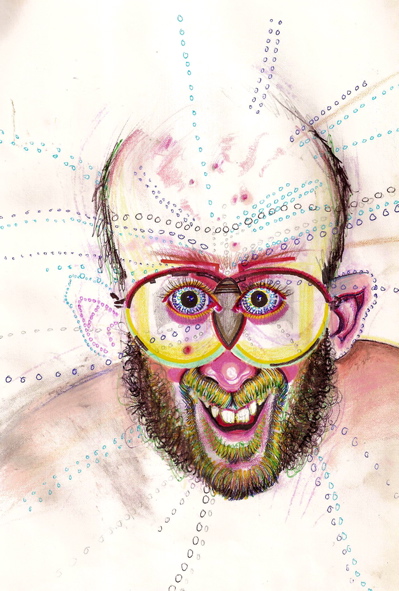
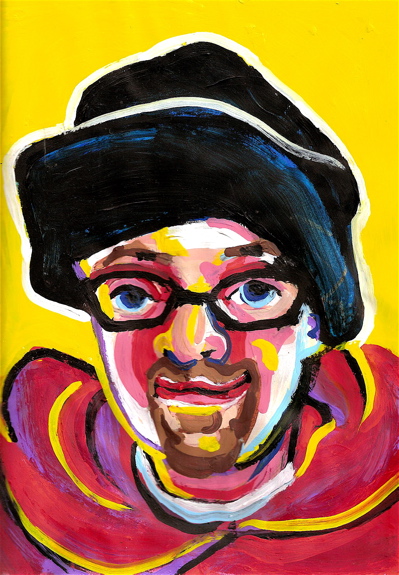
            One piece I really enjoyed was Bryan Lewis Saunders’ series of self-portraits, each while on different drug. It was interesting to see how different mental states would produce completely different images.

Bryan Lewis Saunders' Self Portraits on psilocybin, cocaine and salvia. (Left to right)
Source: <http://bryanlewissaunders.org/drugs/>

            While much controversy surrounds the use of life as an expressive medium, I believe that no harm comes to society as long as artists are aware of the consequences these procedures have on their own bodies, perform them safely and don't harm other organisms unnecessarily. Regarding the use of controlled substances, a significantly more complex issue is presented. Those under the influence may have lapses in judgment (driving while intoxicated) that put others in danger or experience brain damage as a result of improper use, creating a burden on the health care system. Consequentially, a pragmatic ethical approach must be applied to such situations.

Works Cited
Chedotal, A., and L. J. Richards. "Wiring the Brain: The Biology of Neuronal Guidance." Cold Spring Harbor Perspectives in Biology 2.6 (2010): A001917. Web.
Dima, D., Jp Roiser, De Dietrich, C. Bonnemann, H. Lanfermann, Hm Emrich, and W. Dillo. "Understanding Why Patients with Schizophrenia Do Not Perceive the Hollow Mask Illusion Using Dynamic Causal Modelling." NeuroImage 47 (2009): S135. Web.
"DRUGS." Bryan Lewis Saunders. 2008. Web. 19 July 2014. <http://bryanlewissaunders.org/drugs/>.
Frazzetto, Giovanni, and Suzanne Anker. "Neuroculture." Nature Reviews Neuroscience 10.11 (2009): 815-21. Web.
Ilani, Ofri. "Hebrew University Researcher: Moses Was Tripping at Mount Sinai." Israel News. Haaretz, 4 Mar. 2008. Web. 19 July 2014. <http://www.haaretz.com/news/hebrew-university-researcher-moses-was-tripping-at-mount-sinai-1.240589>.
Vesna, Victoria. "Neuroscience Pt3." YouTube. UC Online Program, 16 May 2012. Web. 17 July 2014. <https://www.youtube.com/watch?v=E5EX75xoBJ0>.
Yglesias, Matthew. "Steve Jobs on LSD: "A Positive Life-changing Experience for Me."" Slate Magazine, 11 June 2012. Web. 19 July 2014. <http://www.slate.com/blogs/moneybox/2012/06/11/steve_jobs_on_lsd_a_positive_life_changing_experience_for_me_.html>.